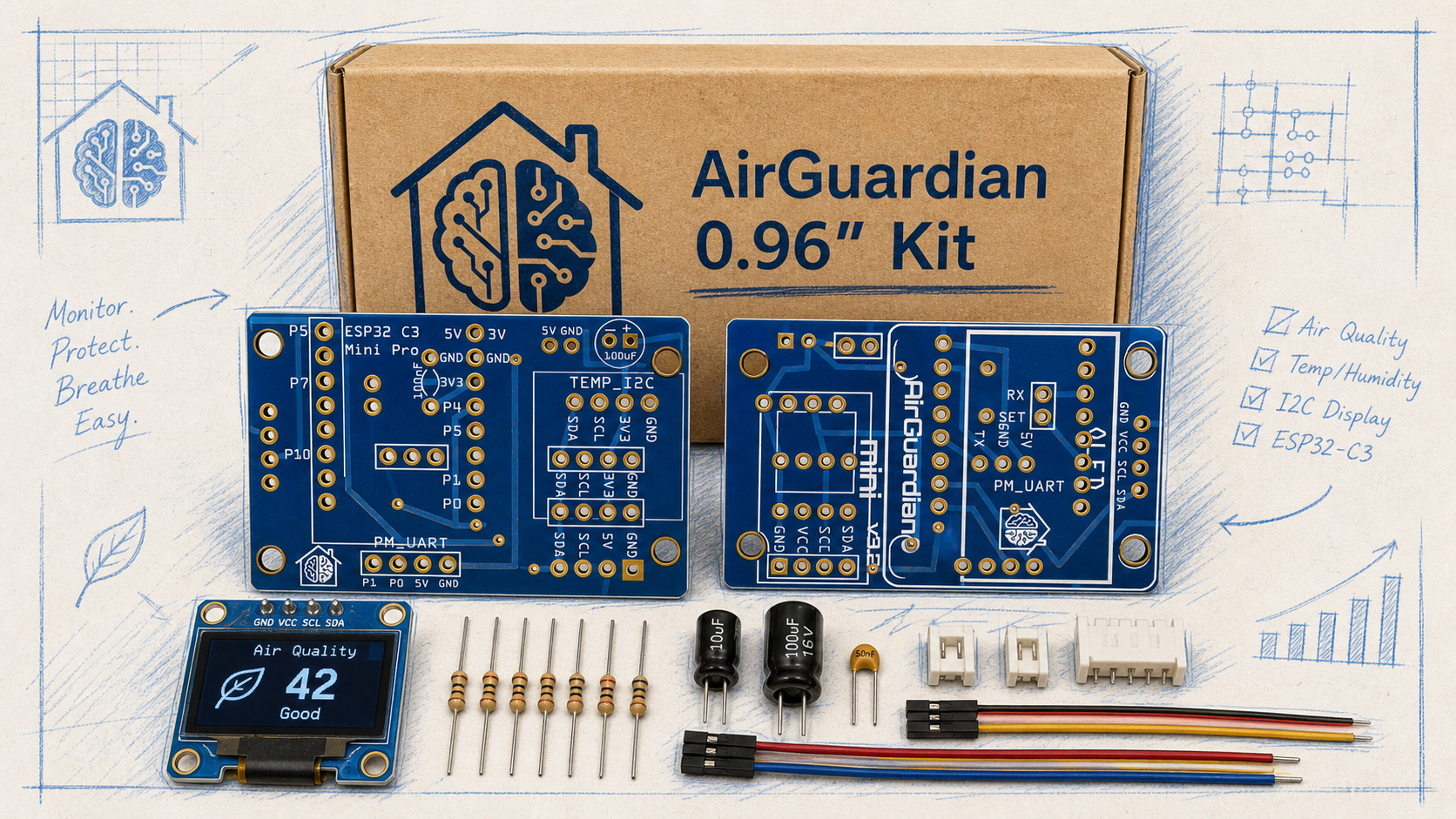
Air Guardian - 0.96'' I2C Display
This is the PCB that powers AirGuardian, our most complex air sensor for indoor monitoring.
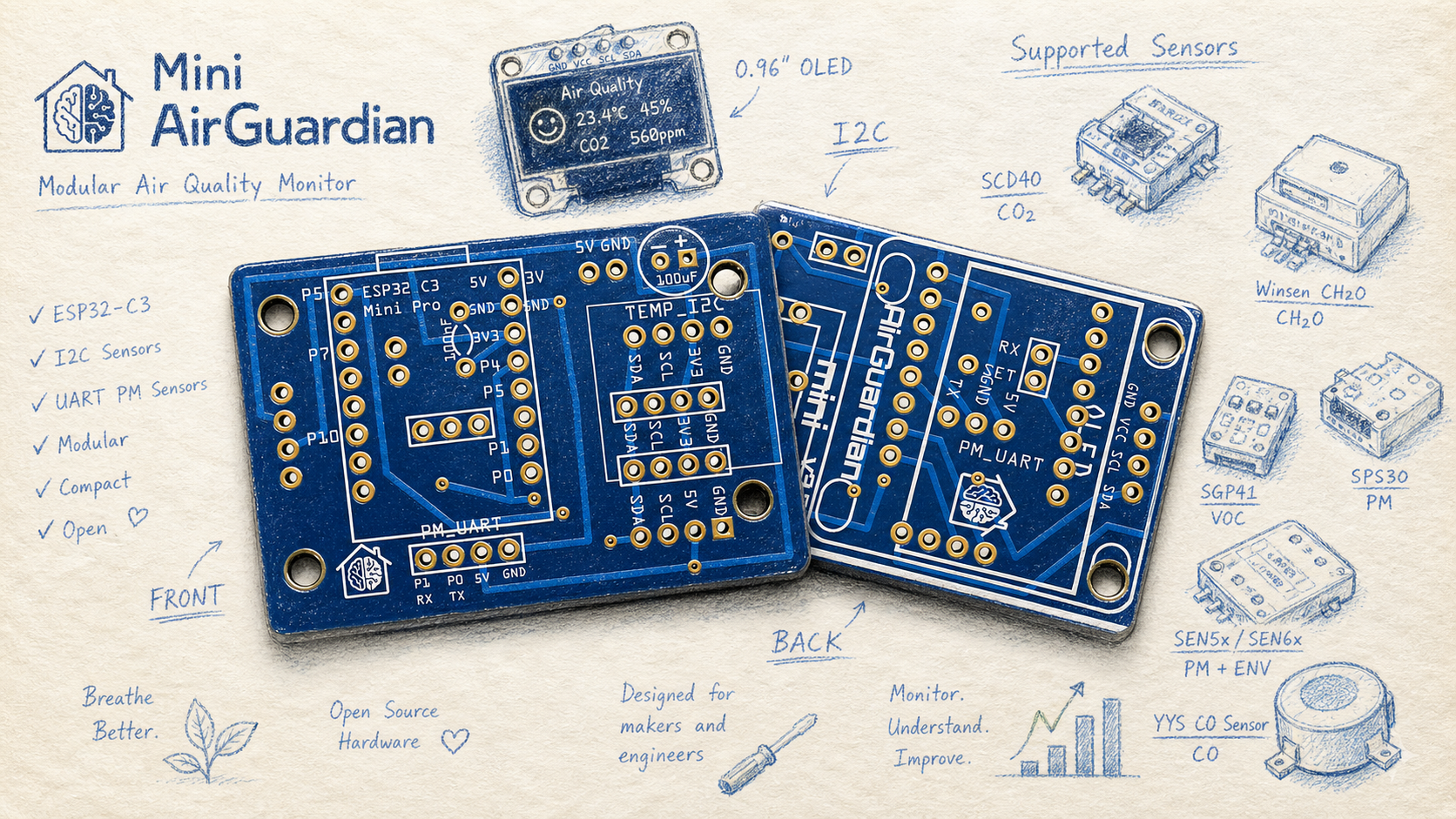
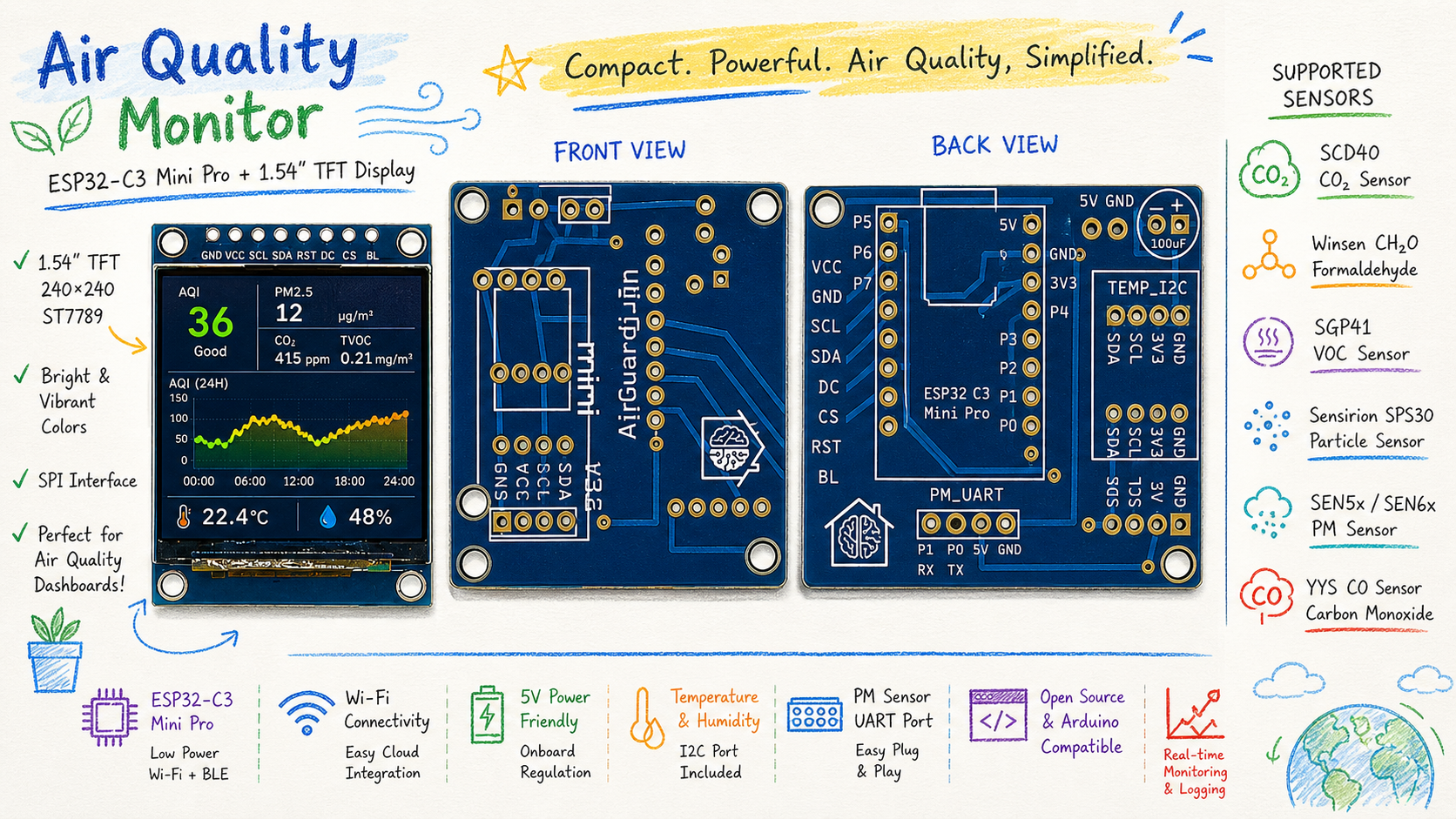
This version of the custom air-quality monitor PCB is also built around the ESP32-C3, which handles sensor acquisition, Wi-Fi connectivity, the local user interface and ESPHome/Home Assistant integration.
It uses the same flexible sensor architecture as the color-display version, but replaces the 1.54" SPI TFT with a compact 0.96" I²C display.
Using an I²C display reduces the number of ESP32-C3 GPIO pins required for the display interface, making it possible to provide a second UART sensor port. This version is therefore ideal for builds that need to use two serial sensors at the same time.
The board provides a general-purpose I²C interface compatible with ESPHome-supported I²C sensors. The display itself shares the I²C bus, and additional compatible I²C devices can be connected as long as their addresses and electrical requirements are compatible.
Possible I²C devices include:
-
Sensirion SEN5x and SEN6x air-quality sensors
-
Sensirion SPS30 particulate-matter sensor
-
Atmospheric-pressure sensors such as BMP280/BME280
-
Temperature and humidity sensors
-
CO₂ sensors
-
VOC and NOx sensors
-
Other environmental sensors supported by ESPHome
The major difference with this PCB version is the availability of two independent UART sensor interfaces.
This makes it possible to combine two UART-based devices in the same monitor. For example, you could use:
-
A Plantower PMS-series particulate-matter sensor together with a Winsen ZE08-CH2O formaldehyde sensor
-
A Plantower sensor together with a YYS SC16-CO carbon monoxide sensor
-
A formaldehyde sensor together with a CO sensor
-
Or another combination of ESPHome-compatible UART devices supported by your firmware configuration
The compact 0.96" I²C display provides local access to the most important measurements while preserving more of the ESP32-C3's GPIO resources for sensor connectivity.
With ESPHome firmware, the finished monitor can operate as a standalone Wi-Fi device with its own configuration interface, or it can be integrated into Home Assistant for historical data storage, graphs, trend monitoring, alerts, automations and device diagnostics.
This version is particularly suited to sensor configurations where UART connectivity is more important than having a larger full-color display, providing a flexible ESP32-C3-based environmental monitoring platform with dual UART support.